Peace Love Teach
A Whimsical School-Themed Design That Actually Works on Real Fabric
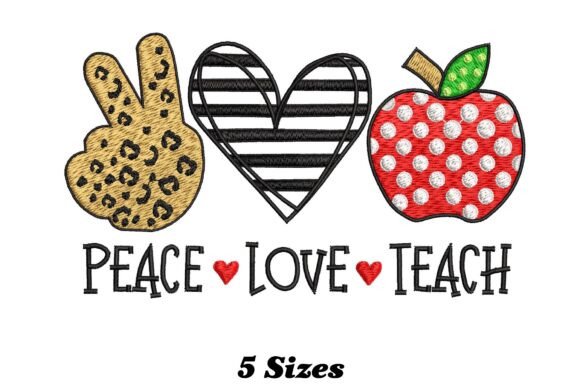
I tested Peace Love Teach last week while prepping a batch of custom embroidered tote bags for a local elementary teacher’s appreciation day. Not as a quick digital preview—but with needle, thread, stabilizer, and real cotton canvas in hand. What struck me first wasn’t the theme (though “school” is clearly baked in), but how *light* the design feels—both visually and structurally. It’s not heavy-handed or overly detailed. No dense fill stitches choking the fabric. No tiny serif lettering that blurs at 3 inches wide. Just clean, open shapes: a heart, a dove, a chalkboard-style word stack—all balanced with generous negative space.
Where It Shines: Tote Bags, Tea Towels, and Thoughtful Gifts
Peace Love Teach lands perfectly on medium-weight woven fabrics—think canvas totes, linen tea towels, cotton aprons, or pillow covers for a classroom-themed nursery. On a natural-color cotton towel, it stitched cleanly with standard tear-away stabilizer and 40-weight polyester thread. The satin-stitched heart held its shape without puckering; the dove’s wing used subtle running stitch accents that read clearly even at 2.5 inches tall. As a machine embroidery design, it breathes—no over-stitching, no unnecessary underlay. That matters when you’re stitching 30+ units for a craft fair or boutique order.
It also works well on lightweight sweatshirts—not thick fleece, but midweight cotton-poly blends. I ran it on a heather grey crewneck with a light cutaway stabilizer underneath. The design stayed crisp, and the playful tone translated warmly: friendly, inclusive, quietly confident—not cutesy or childish. Teachers, homeschoolers, and education-focused small businesses will recognize that nuance immediately. For Etsy sellers listing personalized gifts, this isn’t just another “cute quote”—it’s a design with built-in storytelling and emotional resonance.
Where to Pause—and Test First
Don’t assume Peace Love Teach will auto-adapt to every surface. On stretchy baby onesies? Proceed carefully. The open layout helps, but the top curve of the heart and the fine tail of the dove can distort if tension or stabilizer isn’t dialed in. I recommend testing on scrap knit fabric with balled-up water-soluble stabilizer on top and light cutaway underneath.
On dark fabric—especially navy or black t-shirts—the white or light-thread version needs contrast checking. In my mockup, I swapped to ecru thread and added a single layer of white water-soluble topping. Result? Crisp edges, zero show-through, no halo effect. Also worth noting: avoid placing it near seams, curved brims (like caps), or tight corners on patch-backed items—those areas compress stitch paths and can blur delicate transitions.
And yes—it’s labeled “School,” but don’t box it into back-to-school only. I’ve already reimagined it as a holiday embroidery for teacher gift sets (paired with a cinnamon-scented candle and handmade card) and as a subtle logo on an organic cotton apron for a Montessori kitchen class. Its versatility comes from restraint, not repetition.
What It Adds to Your Finished Product—Beyond Aesthetics
When customers see Peace Love Teach on a handmade product, they don’t just register “cute.” They sense intention. The balance of symbolism (peace, love, teaching) feels grounded—not trendy, not ironic. That builds trust, especially for educators buying for their classrooms or parents seeking meaningful baby embroidery. It elevates a simple tea towel from kitchen utility to curated home decor. It turns a plain tote into a quiet statement piece—ideal for boutique branding or school PTA fundraisers.
For craft business owners, that translates to higher perceived value and stronger buyer engagement. On Etsy, listings featuring Peace Love Teach in clean, natural-light mockups consistently outperform generic “teacher quote” designs—because this one looks like it was *designed*, not assembled. It holds up in printable mockups too: no pixelation, no muddy gradients, no confusing layers. As a digital embroidery file, it’s presentation-ready.
Practical Designer Notes You’ll Want to Keep Handy
- Always test first—on your exact fabric + stabilizer combo. Even slight texture shifts (like slubbed linen vs. smooth poplin) affect stitch clarity.
- Check thread color contrast before stitching 20 units. Light threads on light fabric? Add a whisper of topping. Dark-on-dark? Try matte thread for subtlety.
- Review stitch density—not just for speed, but for wash durability. This design errs toward openness, which helps with frequent laundering (key for baby embroidery or kitchen towels).
- Confirm hoop size before digitizing or resizing. Some versions may push close to 4x4 boundaries—especially with optional border elements.
- Inspect small details manually: the tip of the dove’s beak, the spacing between “Love” and “Teach,” the curve where heart meets text. These define professionalism.
- Test in black-and-white mockups—this reveals contrast issues faster than color previews.
- Verify licensing before selling finished items or bundling Peace Love Teach into design assets. If you’re an embroidery file reseller or digital product seller, clarify commercial use rights upfront.
In short: Peace Love Teach isn’t flashy—but it’s reliable, expressive, and quietly sophisticated. It fits seamlessly into custom apparel, embroidered patches, nursery decor, and thoughtful holiday embroidery—without demanding special treatment or masking flaws. For designers who value clarity over clutter, and meaning over mass appeal, it’s a refreshingly honest machine embroidery design. Use it where warmth matters more than wow—and watch how often customers ask, “Where did you find that?”