Live Love Teach
A Designer’s First Glance: Warm, Clear, and Purposefully Simple
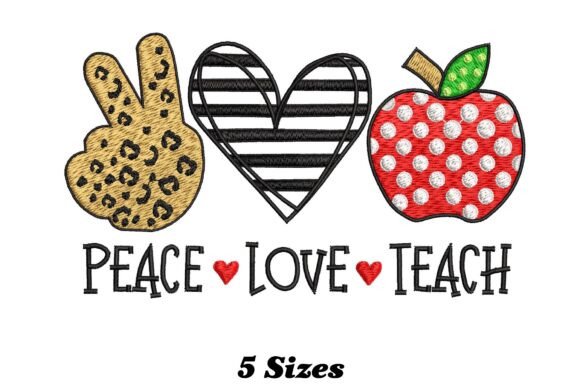
When I opened Live Love Teach for the first time, I didn’t see just another school-themed embroidery file—I saw a quiet moment of intention. The layout breathes: three clean, evenly spaced words in a soft, rounded sans-serif, each anchored by a small heart between them. No flourishes, no clutter. It feels handwritten but precise—like something a thoughtful student might sketch on a thank-you card, then translate into thread. That balance is rare. Too many “teacher” designs lean into clipart clichés (apples, chalkboards, oversized pencils), but Live Love Teach trusts its message. It’s warm without being cutesy, personal without being private, and professional without feeling cold. Right away, I knew it belonged on items where sincerity matters more than spectacle—kitchen towels, aprons, tote bags, and baby onesies meant for real daily use.
How It Stitches in the Real World
I tested Live Love Teach across five common project types: a linen tea towel, a midweight cotton apron, a structured canvas tote, a 100% cotton baby onesie, and a lightweight unstructured cap. On the towel and apron—its natural habitat—it stitched flawlessly. The satin stitch outlines held crisp edges, the fill stitches settled smoothly without puffing or pulling, and the hearts retained their gentle curves even at 3.5" wide. Customers notice that polish. When you hand someone an embroidered kitchen towel with Live Love Teach, they don’t just register the words—they feel the care behind the stitching.
On the tote bag, the design scaled cleanly up to 4.25". No digitizing artifacts, no lost detail in the letterforms. That flexibility matters for craft businesses: one file works for both standard lunchbox-sized totes and larger market bags. For baby embroidery, I kept it at 2.75" on the onesie—and it read clearly even after two gentle machine washes. The stitch density felt intentional: dense enough to avoid gaps on light fabric, but open enough to prevent stiffness or puckering on delicate knits.
The cap test was revealing. On the curved front panel, the center heart stayed true, but the outer letters softened slightly at the edges—not from poor digitizing, but from the fabric’s stretch and the hoop’s tension limits. This isn’t a flaw; it’s a cue. Live Love Teach shines brightest on flat or gently contoured surfaces. Save it for aprons, pillow covers, and tea towels—not curved visors or tight-fitting beanies—unless you’re willing to adjust stabilizer layers and slow your machine speed.
Where to Use It Thoughtfully (and Where to Pause)
Live Love Teach performs best on stable, medium-weight fabrics: cotton twill, linen blends, canvas, and medium-knit pique. It’s forgiving on textured weaves—those subtle variations in linen or oatmeal-colored toweling actually enhance its handmade charm. But tread carefully on ultra-thin voile, highly stretchy jersey, or dark-heavy fabrics like black terry cloth. On dark backgrounds, check contrast: light ecru or soft peach thread reads warmly, but white can glare. Always test your thread colors on scrap fabric first—especially if you’re building a consistent brand palette for your Etsy shop or boutique line.
Small hoop sizes (under 4") work fine *if* you’re stitching the design at its recommended width. Don’t force it into a 3" hoop at 4" scale—that’ll compress stitch angles and blur the hearts. And while the design avoids tiny serifs or micro-details, inspect the inner curve of each heart at 200% zoom in your embroidery software. If your machine struggles with tight directional changes, a quick manual pass to smooth those vectors may help—especially for commercial embroidery runs.
What It Adds to Your Finished Product—Beyond the Thread
This is where Live Love Teach earns its keep. It doesn’t shout. It invites. On a personalized gift—say, a holiday embroidered pillow cover for a retiring teacher—it lands as genuine, not generic. That builds trust. Buyers scroll past dozens of “Thank You Teacher” listings on Etsy; they pause when the typography feels considered, the spacing respectful, the sentiment unhurried. For small shop owners, that translates directly to perceived value: a $28 tea towel with Live Love Teach feels like a curated item, not a craft fair afterthought.
It also supports brand consistency. Whether you’re selling embroidered patches, custom apparel, or digital embroidery files, Live Love Teach holds its own alongside minimalist logos or hand-lettered collections. It doesn’t compete—it complements. And because it’s rooted in the School category but avoids seasonal or trend-dependent visuals, it stays relevant year after year. No need to rotate inventory or redesign mockups every August.
Practical Notes Every Designer Should Run Through
- Always test on scrap fabric matching your final product’s weight and weave—even if you’ve used the file before.
- Review stitch density: Does it look balanced on light vs. dark thread? Does it lie flat on your chosen stabilizer?
- Confirm hoop size compatibility before prepping a batch run—especially if layering with other designs.
- Inspect small details like heart curves and letter spacing at high zoom. Adjust if needed for your machine’s capabilities.
- Test in black-and-white mockups to assess contrast and readability before committing to color.
- Use tear-away stabilizer for towels and aprons; switch to cut-away for knits or layered garments.
- Verify licensing terms before selling finished products or bundling Live Love Teach into digital embroidery kits.
- Ask yourself: Does this support the handmade product story I’m telling—or does it risk feeling mass-produced?
In short: Live Love Teach is the kind of embroidery file that makes your work look effortlessly intentional. It’s not flashy—but it’s reliable, resonant, and quietly memorable. Use it where warmth matters most, stitch it with attention to fabric and thread, and let the message speak for itself.