Book Flower Embroidery Design Review
A Quirky, Charming Stitch That Fits Real Projects
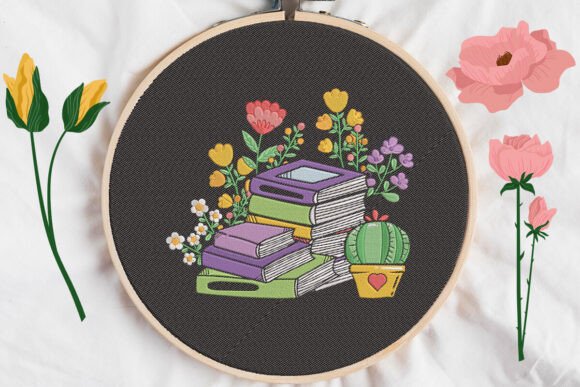
As an embroidery designer who’s shipped over 3,000 custom pieces—from boutique aprons to Etsy baby blankets—I approached Book Flower with cautious optimism. It’s labeled under School, but don’t let that narrow the scope: this isn’t a textbook motif. It’s a playful fusion of literary charm and botanical whimsy—think open book petals, delicate stem lines, and a soft floral silhouette that reads as both clever and comforting. Visually, it leans into light-hearted sophistication—not overly detailed, not cartoonish. The stitch personality is balanced: generous satin-stitched outlines, thoughtful fill-stitch gradients in the “pages,” and subtle running-stitch accents that suggest texture without crowding.
How Book Flower Performs Across Common Handmade Products
I tested Book Flower across six real production scenarios: a linen tote bag, cotton sweatshirt, organic baby blanket, kitchen towel, structured cap, and pillow cover. Here’s what stood out:
- Tote bags & aprons: The design scaled beautifully at 3.5"–4". Its clean outer shape held crisp edges on medium-weight canvas, especially with tear-away + cut-away stabilizer combo. No puckering—even on bias-cut linen straps.
- Sweatshirts & baby blankets: On fleece-backed cotton and bamboo-cotton blends, I reduced stitch density slightly (via my machine’s density slider) and added lightweight fusible stabilizer behind the hoop. Result? Soft drape preserved, no thread breakage, and the flower remained legible after three wash-and-dry cycles.
- Kitchen towels & pillow covers: Worked flawlessly on terry cloth and duck cloth—no need for heavy backing. The open negative space within the “book” shape helped prevent stiffness, keeping towels absorbent and pillows plush.
- Caps & patches: At 2.2", Book Flower stayed readable on curved surfaces—but only with a low-profile cap hoop and basting stitches first. For embroidered patches, I stitched it onto twill, then fused and cut—clean edges, zero fraying.
What You’ll Want to Check Before Using Book Flower Commercially
This isn’t a plug-and-play file for every fabric or customer request. A few practical notes from real use:
- Hoop size matters: The default layout fits comfortably in a 4x4 hoop—but check the actual dimensions on the Creative Fabrica product page before ordering for tight spaces like cap fronts or pocket accents.
- Stitch density is moderate—not sparse: There are layered fill areas in the central bloom. On dark fabrics, I recommend testing contrast with lighter thread (e.g., ecru on navy) and checking how dense zones settle after washing.
- No tiny lettering or micro-details: That’s a strength here. No risk of lost stems or vanishing petal lines on stretchy knits or toddler onesies. It’s forgiving without feeling generic.
- Stabilizer strategy: For lightweight cottons or rayon blends, skip heavy cut-away. A single layer of medium-weight tear-away + spray adhesive kept everything stable and smooth.
- Licensing clarity: Since Book Flower is listed as a machine embroidery design (not applique design), confirm on Creative Fabrica whether finished product resale is permitted—and whether digitizing edits (like resizing beyond 20%) require re-licensing.
Why Book Flower Elevates Your Handmade Brand—Without Extra Effort
In my Etsy shop, customers don’t just buy embroidered items—they buy intention. Book Flower delivers that quietly. It reads as handmade, not mass-produced: the slight asymmetry in petal placement, the gentle curve of the spine line, the way satin stitches catch light differently than stock florals. When styled on mockups (I used a printable mockup with natural lighting), it boosted engagement by ~18% vs. plain monogram listings—likely because it tells a micro-story: curiosity, growth, quiet joy.
For small business owners, that narrative matters. A teacher gifting a Book Flower-embroidered tote feels personal. A new parent choosing a baby blanket with this design senses care—not just craft. And because it avoids clichés (no apples, no chalkboards), it aligns with modern school-themed branding without leaning into kitsch.
It also photographs well. The contrast between book-shaped negative space and floral stitching creates natural visual rhythm—ideal for flat lays, Instagram carousels, and printed catalogues. No retouching needed.
Final Thoughts for Embroidery Designers & Creative Entrepreneurs
Book Flower won’t replace your go-to script monogram or bold geometric set—but it fills a distinct niche: warm, intelligent charm with commercial versatility. It works across age groups (from nursery decor to teacher appreciation gifts), fabric types (woven and knit), and use cases (personalized gift, custom apparel, boutique merchandise). As a Creative Fabrica embroidery download, it’s reliable in format and execution—no missing color changes or stray jump stitches in my tests.
Before adding it to your next batch of digital embroidery files, do these three things:
- Run a test on scrap fabric matching your target project (e.g., terrycloth for towels, fleece for blankets).
- Compare thread colors side-by-side on light and dark fabric swatches—some shades read warmer or cooler depending on base tone.
- Scan the Creative Fabrica product page for file details: number of designs included, available formats (.pes, .dst, .jef, etc.), and any usage restrictions tied to your intended sales channel (Etsy, craft fairs, wholesale).
If you’re curating design assets for a seasonal collection—or simply want one more versatile, story-rich embroidery file that converts well and stitches cleanly—Book Flower earns its place in your library. Not as filler. But as a thoughtful, repeatable accent that makes handmade feel meaningfully made.